Is the WTI–Brent spread tradeable?
WTI usually trades close to Brent, and when the gap stretches it tends to come back. I measured how fast it comes back across almost 40 years of daily prices, then tested a simple rule that trades the stretch.
- Built with
- Python, pandas, statsmodels
- Data
- EIA daily spot prices, May 1987 to November 2026
- Method
- AR(1) half-life, Dickey–Fuller test, walk-forward z-score rule
How fast it comes back
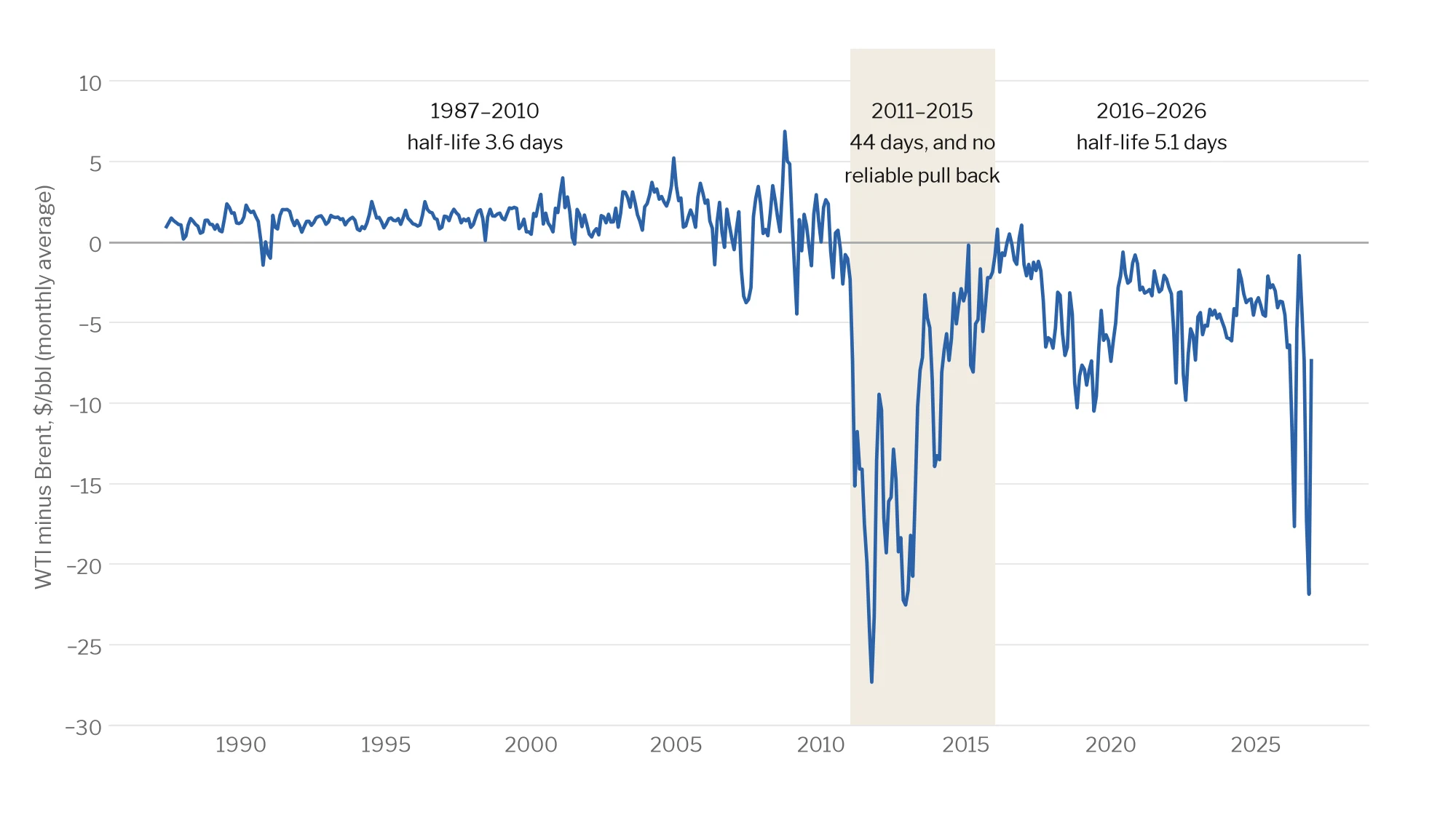
I regressed each day's change in the spread on the day before's level, an AR(1), in three periods. Before 2011 half of any gap closed in about 3.6 trading days, and since 2016 in about 5.1.
In between it took 44 days, and an augmented Dickey–Fuller test couldn't rule out a random walk (p = 0.26). That was the stretch when the gap could stay wide for months.
The rule
Every day I compare the spread with its average over the previous year. When it's more than two standard deviations away, I bet on it coming back, and close when it crosses the average or after 60 trading days. Each round trip pays $0.10 a barrel in costs.
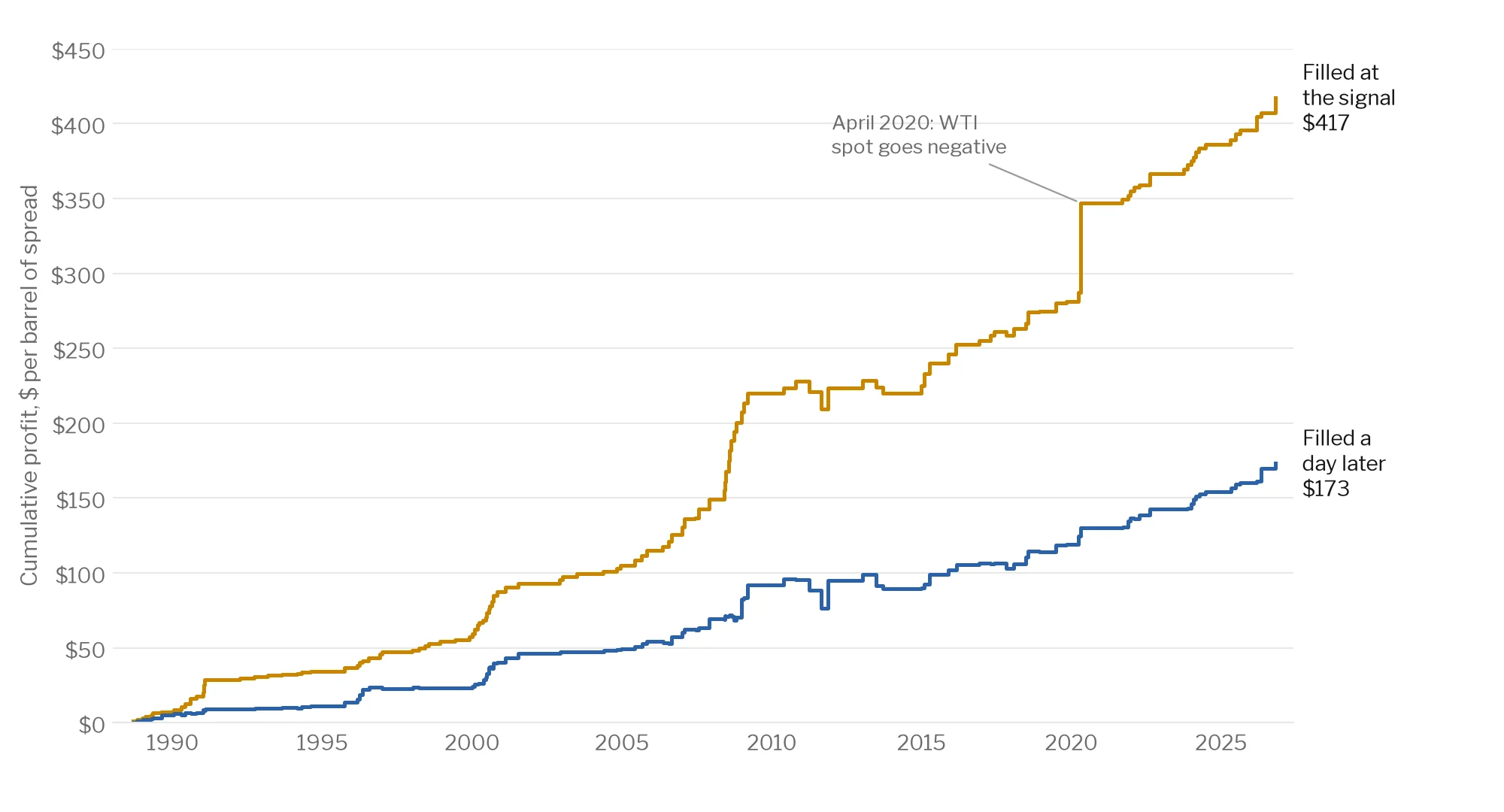
Filled at the same day's price, 124 trades won 96% of the time and made $417 a barrel in total. That looked too good, so I filled every trade a day later instead. The win rate fell to 77% and the total to $173.
What I took from it
Two things explain the gap. The two spot prices are assessed at different times and places, so some one-day spikes were never tradeable, and one trade in April 2020 happened to catch WTI going negative.
Before trading it I'd move to futures with real roll dates, add bid–ask costs and size by volatility. The 2011 to 2015 period is the warning: when the spread stopped mean-reverting, the worst trade lost about $12 a barrel before the 60-day stop closed it.